Robert Gilbert Livingston Chapter, NSDAR
Georgetown, Texas
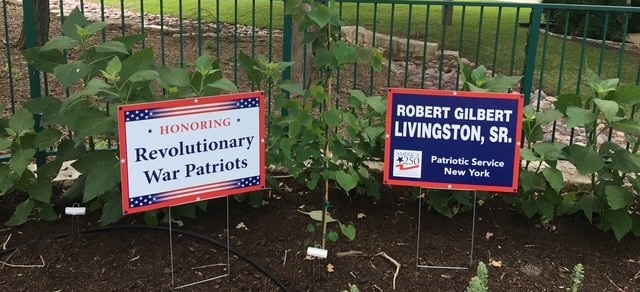
As part of our American 250! project to bring awareness to the public of our nation's 250th anniversary, we created Patriot signs.
These two were in a demonstration garden when we dedicated a Texas Red Bud tree.
As we look back at the accomplishments of our ancestors, we strive to continue their work by honoring our history, participating in the present, and having faith in our future. By doing these things, we hope to benefit our chapter as well as the National Society of the Daughters of the American Revolution (NSDAR OR DAR) through our dedication to God, Home, and Country.
CHAPTER HISTORY
The Robert Gilbert Livingston Chapter, NSDAR, was formed on June 26, 2006, in Sun City, Georgetown, Texas, at the request of State Regent Florence Fitch Patton. Catharine Browning and 16 organizing members formed the chapter. The Robert Gilbert Livingston Chapter, NSDAR, received its charter April 29, 2008. In the years since 2008, we have grown to more than 160 members. Come join us and continue to grow with us!
Robert Gilbert Livingston was born on December 24, 1712, into a large and influential family in Kingston, Ulster County, New York. In the American Revolutionary War, most of the men in the Livingston family identified with the Whig cause. One of the few exceptions was Robert Gilbert Livingston, who became a New York City resident early in life. As a merchant, he amassed a fortune, had a handsome home in the city, and owned real estate on Long Island. He inherited considerable Dutchess County acreage from his mother, which she had received from her father, Henry Beckman.
Livingston assisted in establishing American independence while acting as a major in the First Regiment of Minute Men in New York. He served as colonel and deputy adjutant general in the Northern Army under General Schuyler, and was a member of the Provincial Congress in 1775-1776.
When the Americans lost New York City, Livingston retired to Dutchess County and endeavored to steer a neutral course. Although he was successful, the British seized his New York and Long Island properties. As a consequence, his relationship with his Whig relatives suffered. In 1781, Livingston moved from Dutchess County to the village of Sharon, Connecticut. He returned to New York City after the British evacuation in 1783, suffered a long illness with gout and died at the age of 76 on October 27, 1789. He was buried in the family vault in New York County, New York.
Last updated: august 15, 2026 
|